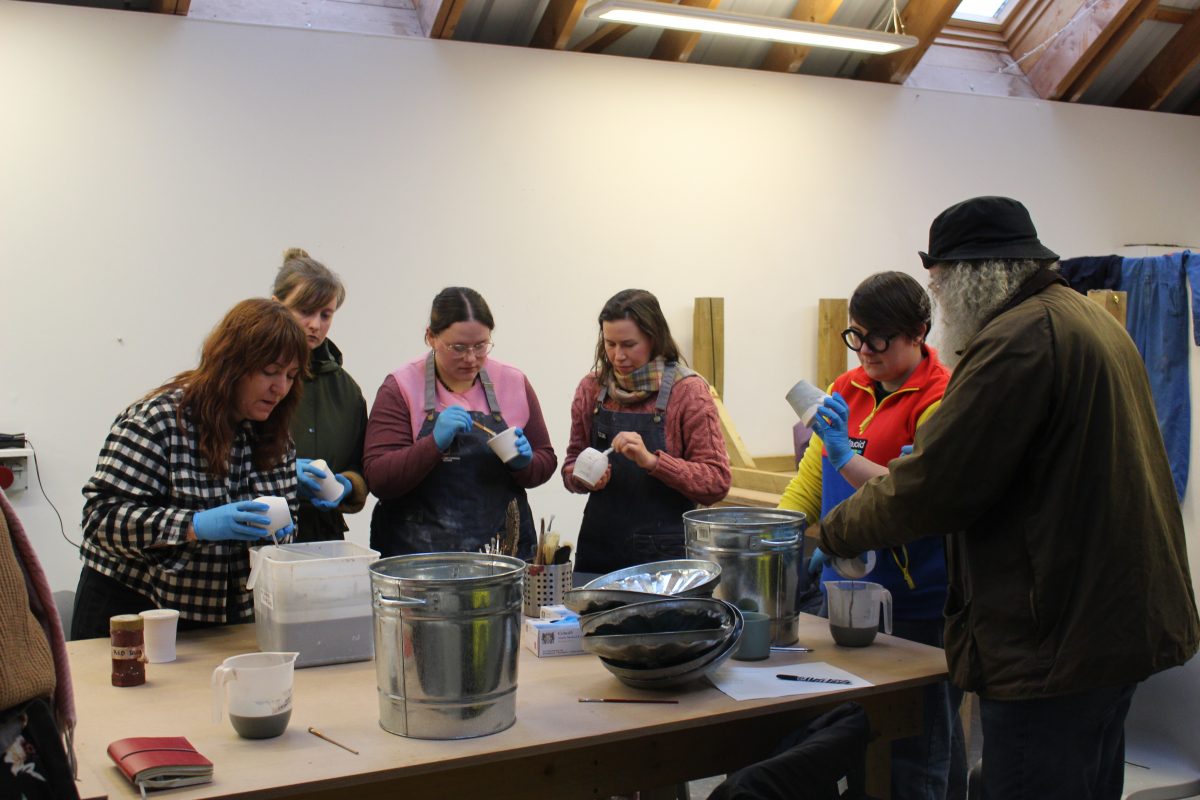
In February 2026, students from the MA Art & Design programme at Gray’s School of Art visited Scottish Sculpture Workshop as part of the Critical and Contextual Studies module, led by Dr Jennifer Clarke.
The visit formed part of the programme’s research-led approach to practice, which explores how knowledge is generated through material engagement, site-responsiveness, and interdisciplinary making environments. Rather than a standalone workshop, the session was embedded within the curriculum as a way of examining relationships between theory, field-based learning, and processes of making.
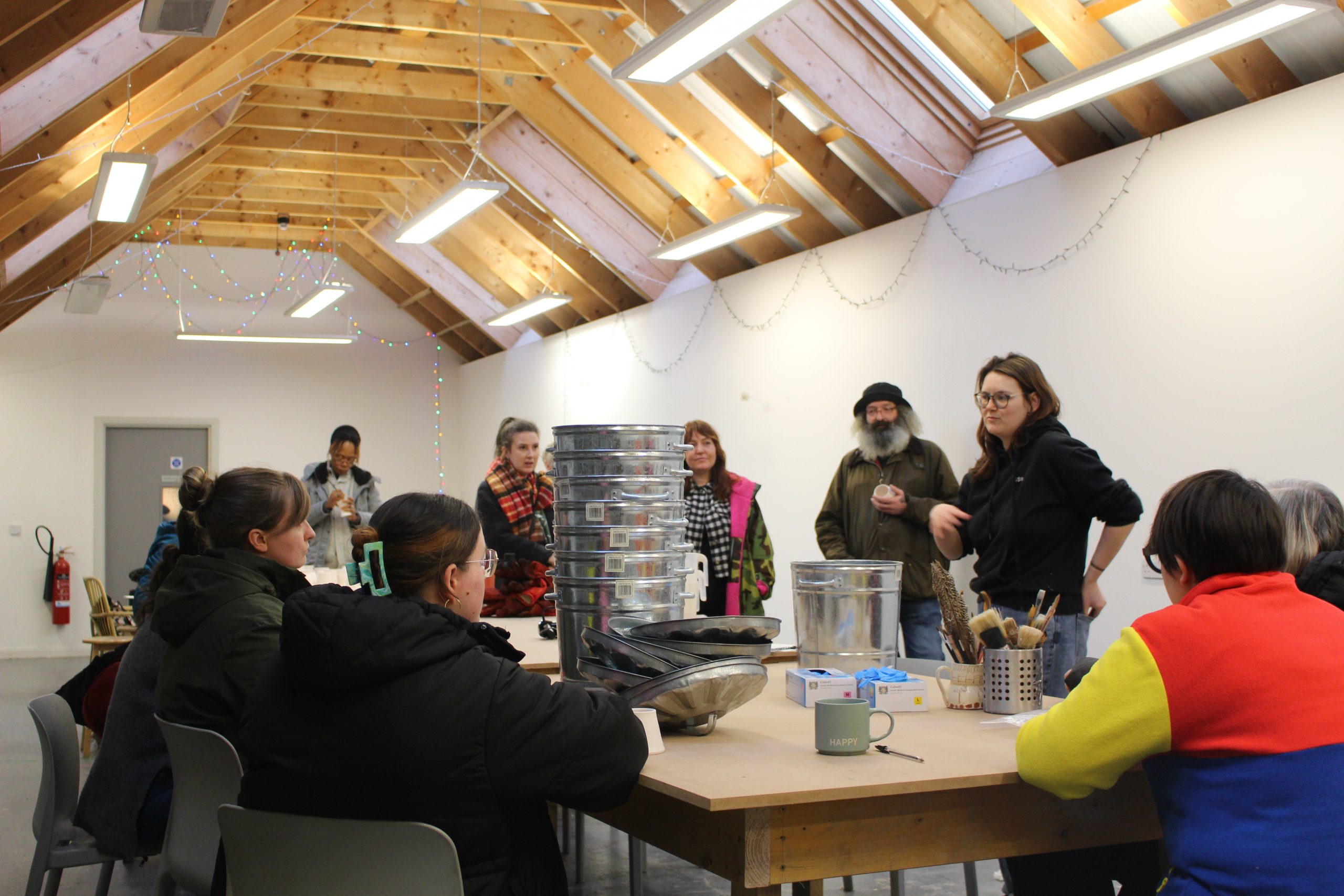
Working with the facilities and technical expertise at Scottish Sculpture Workshop, students encountered raku firing as a material process through which questions of experimentation, transformation, and situated knowledge could be explored within their wider postgraduate research.
The following reflection was written by Gabby Morris, MA Art & Design student, responding to the visit as part of her ongoing practice and study.
Images by Gabby Morris and SSW, poem by Jaqui Shortland
–
Red Heat, Cold Air
We arrived to snow and a kind of quiet that felt structural rather than peaceful. The hills around Lumsden held their shape in white. Fences, tracks, roofs were edged in frost and a sprinkling of snow. Rurality there was not picturesque, it was spare, exposed, materially present the perfect place for sculptural making. The cold pressed against my body and made me aware of my own outline. There was something about the openness of the site, the distance from urban tempo, that shifted attention almost immediately toward material and process. I felt ready to begin before I had decided what beginning would look like, the rawness of the place seemed to authorise experimentation, to make trying feel more necessary than refining. The environment sharpened my appetite for risk; it encouraged a mode of working that was provisional, responsive, less concerned with resolution and more willing to test what the material might do if I allowed it to lead.
Over two days we worked with Raku, thinking alongside Elizabeth Povinelli and her writing on geontologies, on the distinctions between Life and Nonlife that organise so much of Western thought. In that landscape, with ceramics in our hands and snow around us, those categories felt less stable.
I have worked with ceramics before, and there is always an element of surrender. Clay slumps, glaze runs, kilns misbehave, but for me Raku sharpened that. The process is abrupt but beautiful. You heat quickly, remove quickly, expose the work to air and combustible material. The glaze does not settle politely into intention. It flashes, cracks, pulls metallic colours from the surface and it is less about refinement and more about encounter.
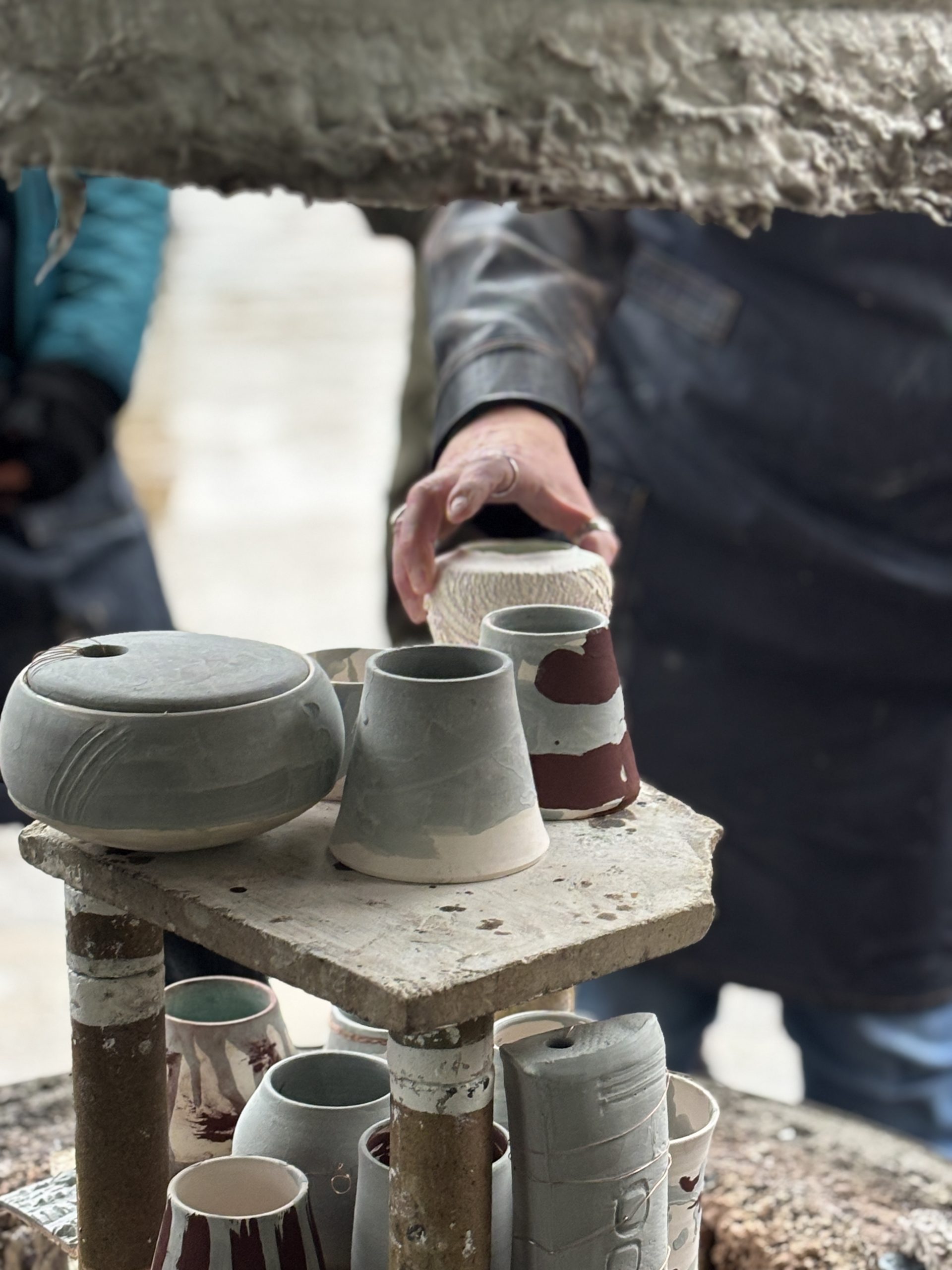
At the start of the process we stacked our bisque-fired pots into the Raku kiln, building upward because space was limited. The forms leaned into one another, lip against base, shoulder against rim. It became a temporary totem, a vertical line of collective labour balanced inside a metal chamber. There was something precarious in it, a trust that the structure would hold long enough for transformation to occur. I held my breath as Kerry (who had made all the brilliant pots for our group) and Amy Benzie (SSW Ceramics Technician) placed the pots and kiln shelves carefully and consciously inside the kiln. We closed the lid on that small tower and stepped back.
What changed for me was not simply that outcomes were unpredictable, it was the intensity of contact. I stood close to the kiln and felt the heat on my face while snow gathered at my feet, the wind whipped around us but the flames from the kiln and the glowing pots inside were not something to miss and head inside. My hands by the end of the waiting were almost as red as the pots that were lifted with tongs from the kiln. You are aware that a second too long or too short changes everything. The material does not wait for you to decide.
When we opened the Raku kiln the pots did not resemble vessels so much as embers. They glowed red and amber, heat visible on their surfaces. We lifted them carefully with tongs and lowered them into metal bins packed with combustibles. There was a sharp chink as red hot clay met freezing air and sleet. The sound was startling, not because I did not know they might crack, but because the contact felt immediate and unmediated. It returned me to something elemental, fire, water, earth were not concepts or materials at a distance; they were colliding in front of us. The cold struck the heat, the steam rose and for a moment the process felt stripped back to force, real elemental, visceral force.
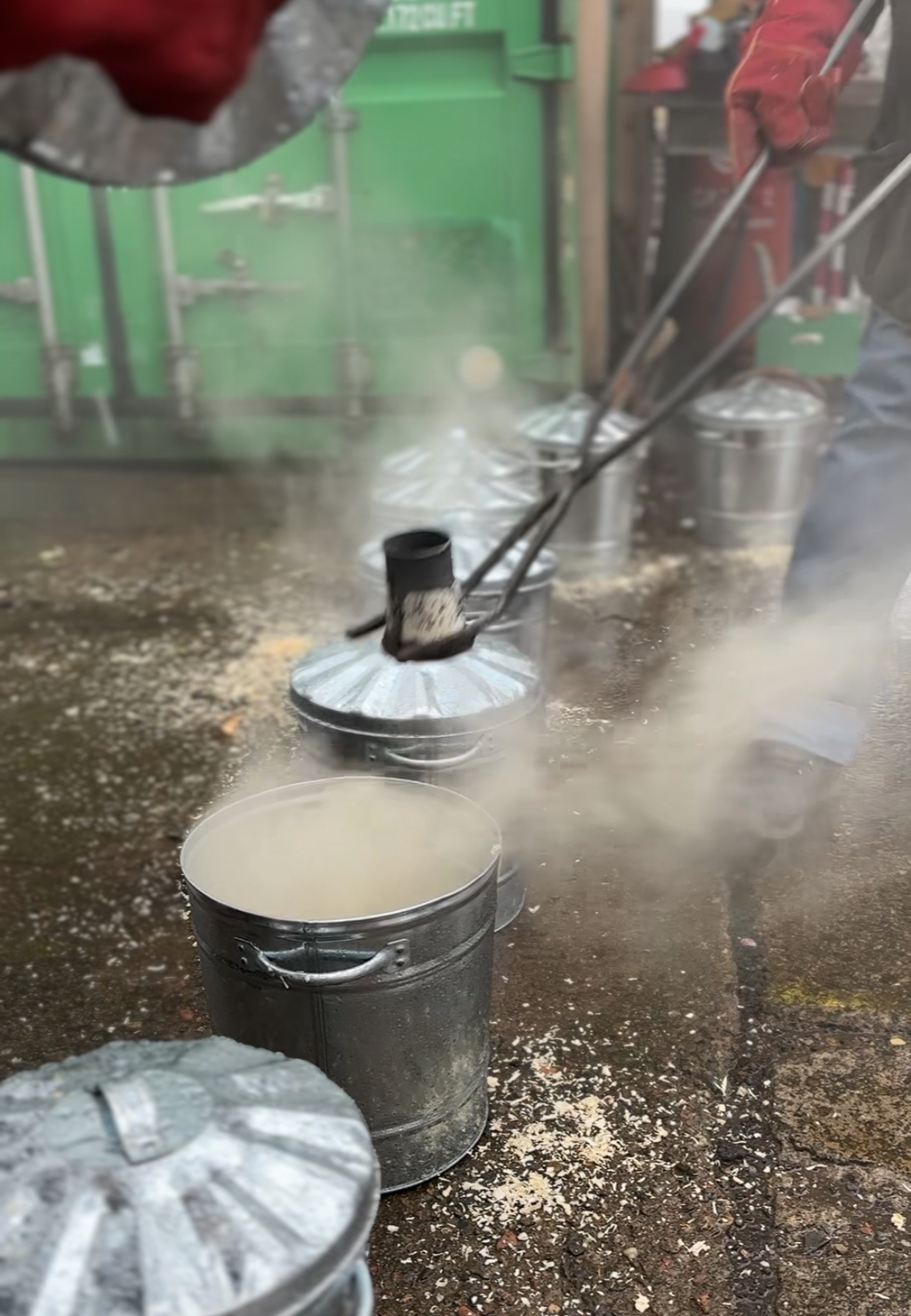
The metallic sheen did not appear until later. After roughly forty minutes we lifted the lids from the charred, sawdust-filled bins and looked inside. The pots had shifted again. Surfaces glistened with oil slick blues, greens and darkened copper tones against the matte black of the combustibles. At that point I still did not know whether my pot had survived intact. There is always a physical response when opening a kiln, a tightening before recognition, regardless of outcome. This felt heightened, the process was not powered by a switch or regulated by a digital panel. It relied on oxygen (and lack of), flame, smoke and the results carried the trace of that exposure.
Reading Povinelli in that context kept drawing me back to questions of endurance and the terms that define it. For Povinelli, part of the conceptual move of geontology is to unsettle the assumed divide between Life and Nonlife that underpins much of Western thought. In her framing, distinctions between living and inert forms are not neutral, they are historically embedded lines of power that shape how existence itself is made legible or extinguished
In that snowy workshop beside the kiln those questions became tactile. Clay, for all its capacity to last, fired centuries old and found in archaeological layers, was also at that moment intensely susceptible to rupture. Glaze carried the trace of fire before it ever carried the trace of intention. Snow melted within minutes of touching warm metal. What persisted, and what vanished, did not conform to easy categories of alive or inert. The material world felt entangled with forces, fire, cold, combustion, gravity, that resisted the kind of stable classification Povinelli critiques.
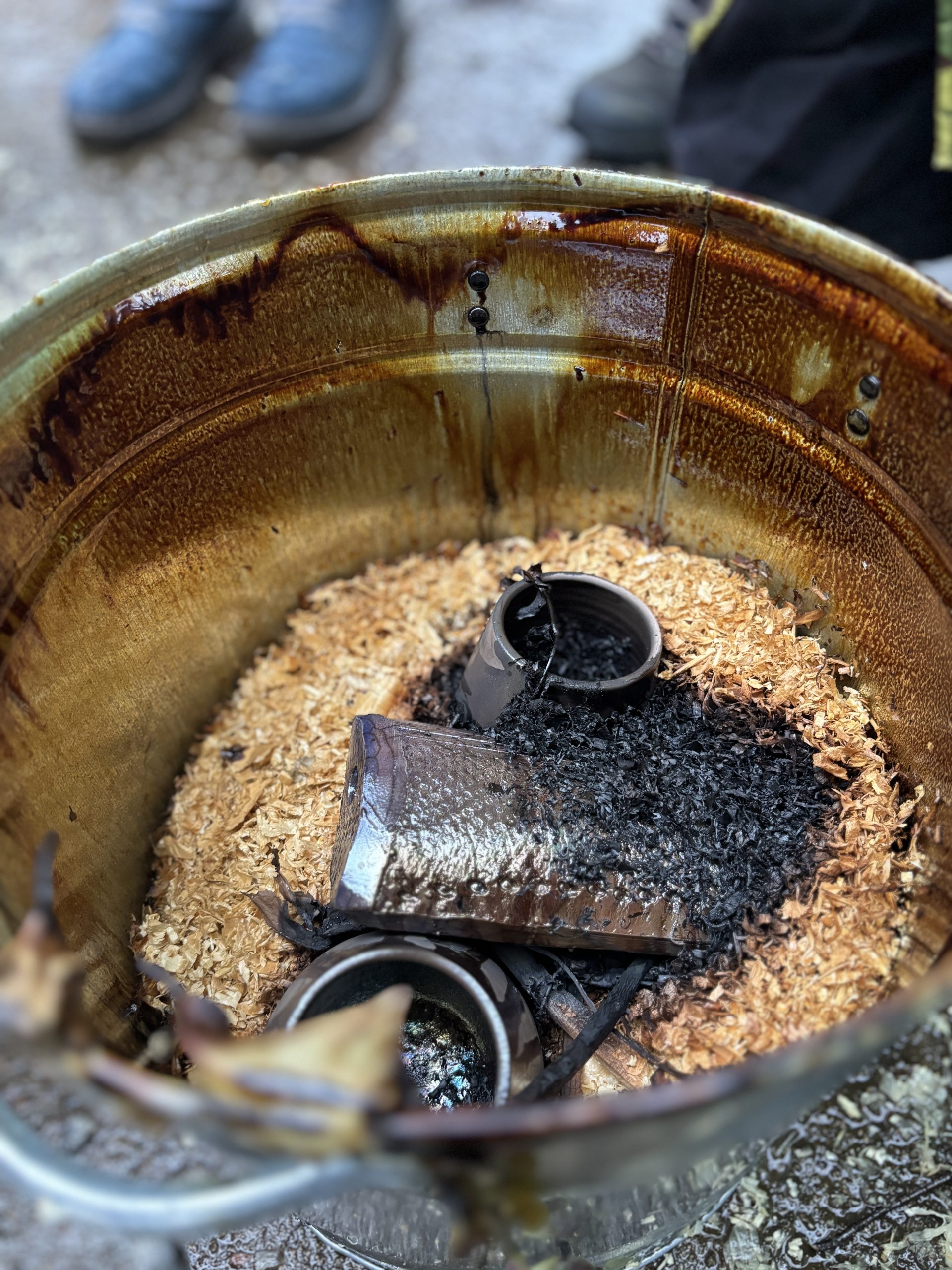
Letting go of control in this setting was not an abstract exercise, it was practical. You cannot negotiate with thermal shock, you cannot persuade smoke to travel differently through sawdust. The work asked for attention rather than mastery. It required a responsiveness to forces that were already in motion and are in motion around us all the time: weather, heat, gravity, the chemical composition of glaze, but SSW heightens the senses of this in your work.
The poem written by Jaqui Shortland (below) in response to the trip captured that compression of focus around the kiln, the way the world narrowed to breath and temperature. I recognised the moment it described, when a pot broke and the rupture became instructive rather than disappointing. Clay and ceramics often tell us, as makers, when something is finished, when it has been worked enough. We spoke about this in our sessions: how to relinquish the need for control and give way to an understanding of the material, to recognise its aliveness. For me, clay in particular feels living. When you work with something living, you work with its rhythm rather than imposing your own, responding as much as directing.
By the end of the second day I found myself less concerned with producing resolved objects and more attentive to the conditions that had shaped them. Thinking about the cycle of heating, lifting, burying and revealing shifted the emphasis away from outcome and toward encounter. We had gathered around, brushing back ash, trying to read surfaces still darkened with smoke. There was excitement in that collective unveiling, not simply because the results were unpredictable, but because the materials had clearly exceeded our plans. Metallic sheens, crackle lines, unexpected fractures. Each piece felt less authored and more co-produced.
What stayed with me was that shared investigation. We were not only making objects; we were testing how far we could follow the material without retreating to control. The joy came from exposure, from seeing what fire and oxygen had done in our absence, from recognising that something had occurred beyond our management.
What I carried back from SSW was not simply two finished pieces but a recalibration in my practice. I returned with a stronger sense of making as negotiation rather than imposition, as an ongoing adjustment to forces already at work. The experience did not resolve questions about control, but it shifted their terms. It left me more willing to work within uncertainty, and more attentive to the conditions that quietly determine what a form can become.
I am grateful and so are my class to the team at SSW for the generosity of their support and technical knowledge, and for creating an environment where play and experimentation feels possible. The care taken in guiding the Raku process, from loading to reduction, made that intensity feel held rather than hazardous. I am equally thankful to the group I worked alongside, for the shared attention, the conversations around control and material, and the collective excitement at each reveal. The work was individual, but the learning was distinctly communal.
–
Poem by Jaqui Shortland
Sleet needles the air,
wind carving its own lines
across our faces.
Huddle around the kiln —
a fierce power
spitting its language of fire.
Focus narrows to heat and breath.
Smoke rises,
an unravelling, bubbling,
glowing pots held gently, deliberately, with loving care.
Rainbow glaze refuses obedience:
oil‑slick blues,
rust blooming from nowhere,
a shimmer that slips away
One pot breaks —
a line of flight
cutting through the cold.
In its rupture,
a truth the intact ones never learned
to speak.
Grosz murmurs through:
chaos, territory, art —
earth as force,
art as a frame.
Her words settle into the cracks,
into the smoke in my hair,
a small territory remade.
By the end
we are all a little scorched,
a little unmade,
carrying home the weather,
carrying the break
as a new kind of beauty.
–
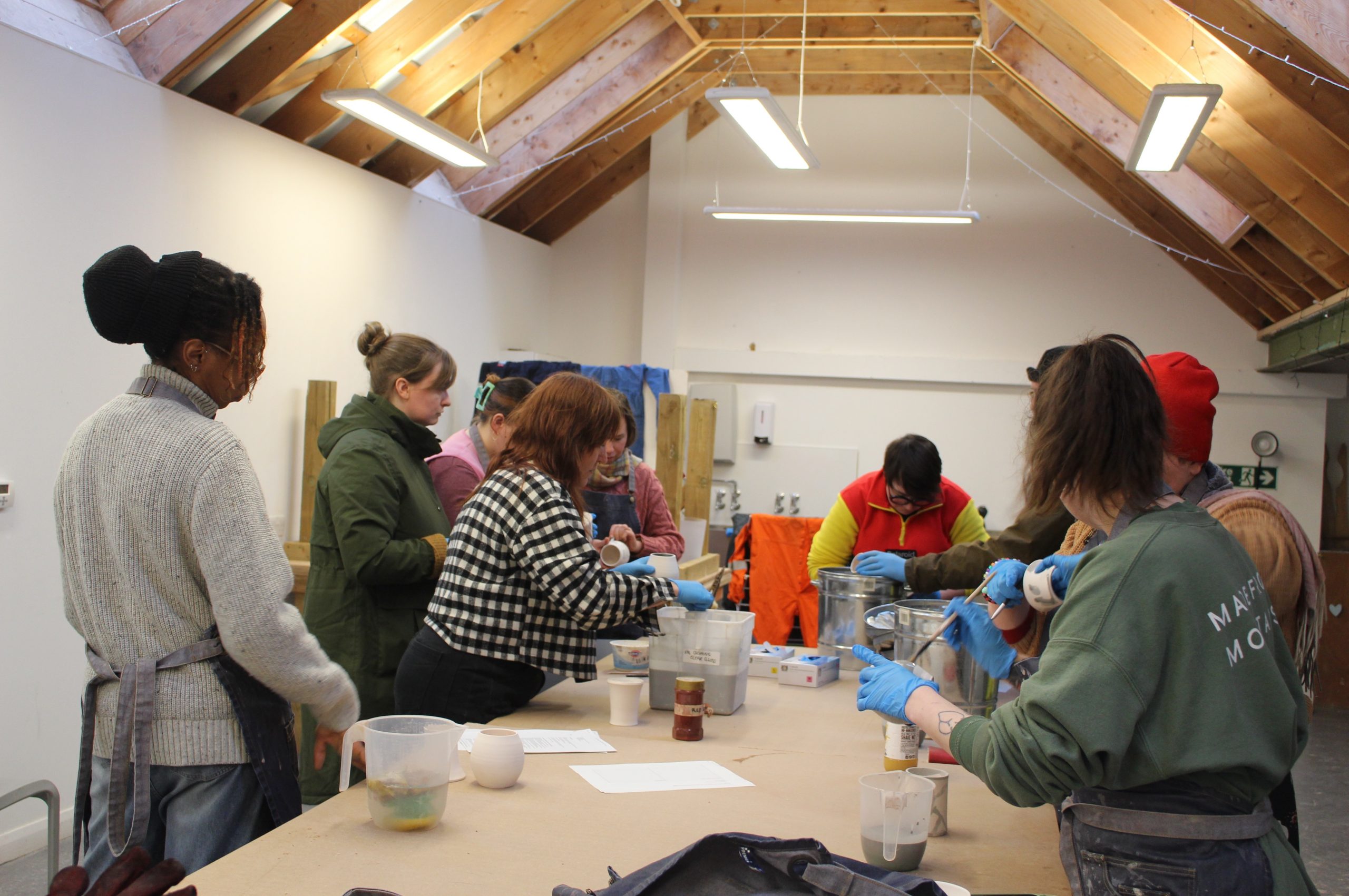
This visit was organised through Gray’s School of Art as part of the MA Art & Design curriculum, led by Dr Jennifer Clarke, with technical support and hosting provided by Scottish Sculpture Workshop.