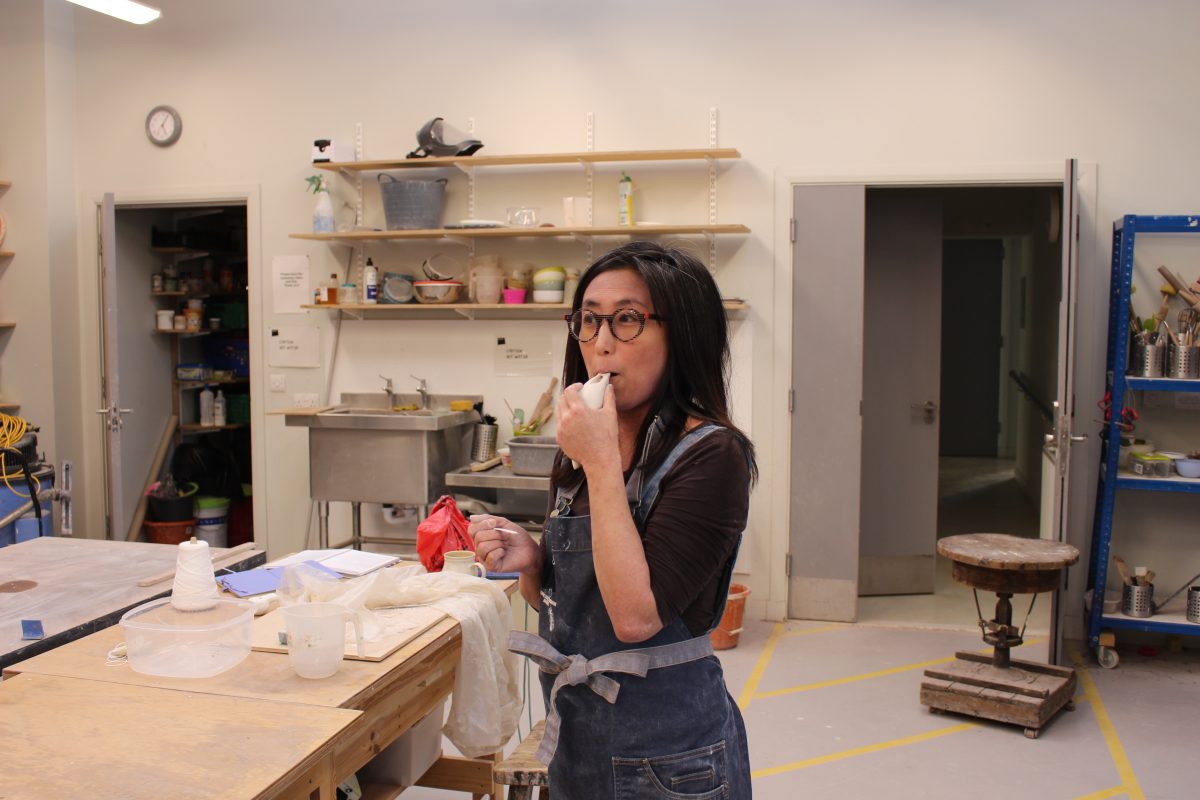
Shiori Usui, one of the five 2025 SSW x Counterflows Caregivers Residency artists, reflects on her time here at SSW in April and May.
The SSW x Counterflows Caregivers Residency was set up in 2020 to expand funded residency opportunities to artists who are also caregivers.
Words, images and video below by Shiori Usui.
—
Wow, what intense but magnificent days they were. Thinking back to the days I spent on the Caregiver’s Residency at Counterflows Festival and SSW, these are probably the words that I would use to sum up my time on residency: intense but magnificent.
My Caregiver’s Residency kicked off by attending Counterflows Festival. Living away from the central belt of Scotland and having childcare duties made it difficult to attend the festival previously, so the opportunity given by the residency to attend this festival was really exciting. I loved the community feel of the festival so much, and I loved the accessibility of experimental music making. As a free improviser with a strong passion for playing inside piano, seeing and hearing the upright piano by Annea Lockwood in the community garden gave me a sense of comradely, and meeting and chatting with her in person sparked delight and fresh energy.
I arrived at SSW open minded. I knew that I wanted to spend this time grieving for my dad, and use the experience of myself dancing to techno music only two days after my father’s death – feeling that there is something strong in this interaction of grieving, dancing and music, as a foundation to the residency. However, what I did not know, was how exactly I could make use of the amazing facilities such as ceramic and metal studios that SSW offers.
Therefore, I think that to a large extent, it was the conversations with various beautiful individuals, including the fellow artists, the members of staff at SSW and the Ceramic Subscribers, whom I met at the residency, that eventually led me to the idea of making a ceramic sound mask and the musical instruments.
There were so many interesting moments of reflection, discovery and learning, connecting with the grieving for my father during my Caregiver’s Residency. So here are some of these moments:
Ceramic Sound Mask
What is the ceramic sound mask? It is a mask made of clay, and a mask that is also a musical instrument. I decided to make this, because at the time when I danced to techno music after my father’s death, I was wearing a work-in-progress costume. There were also work-in-progress props and work-in-progress lighting (it was a run-through of a theatre show in front of a mock audience). I did not quite know how I would actually feel performing in front of the people I did not know so soon after my father’s death. However, I found that having these costume, props and lighting (even though they were work-in-progress) helped me to mentally shield myself from the audience, and to get into the “zone” that was something between very public and very personal at the same time. It was in there that I felt the loss of my father very intensely, and it was in there that I felt a sense of connection to the other fellow humans. Therefore, I thought that a mask might also be one of the ingredients that could help create a similar kind of effect when someone is in grieving. An object that helps you to travel between a space that is “here and now” and somewhere beyond our control.
And why the musical instrument attached to the mask? Because my father loved music so much. It was a personal tribute to my dad.
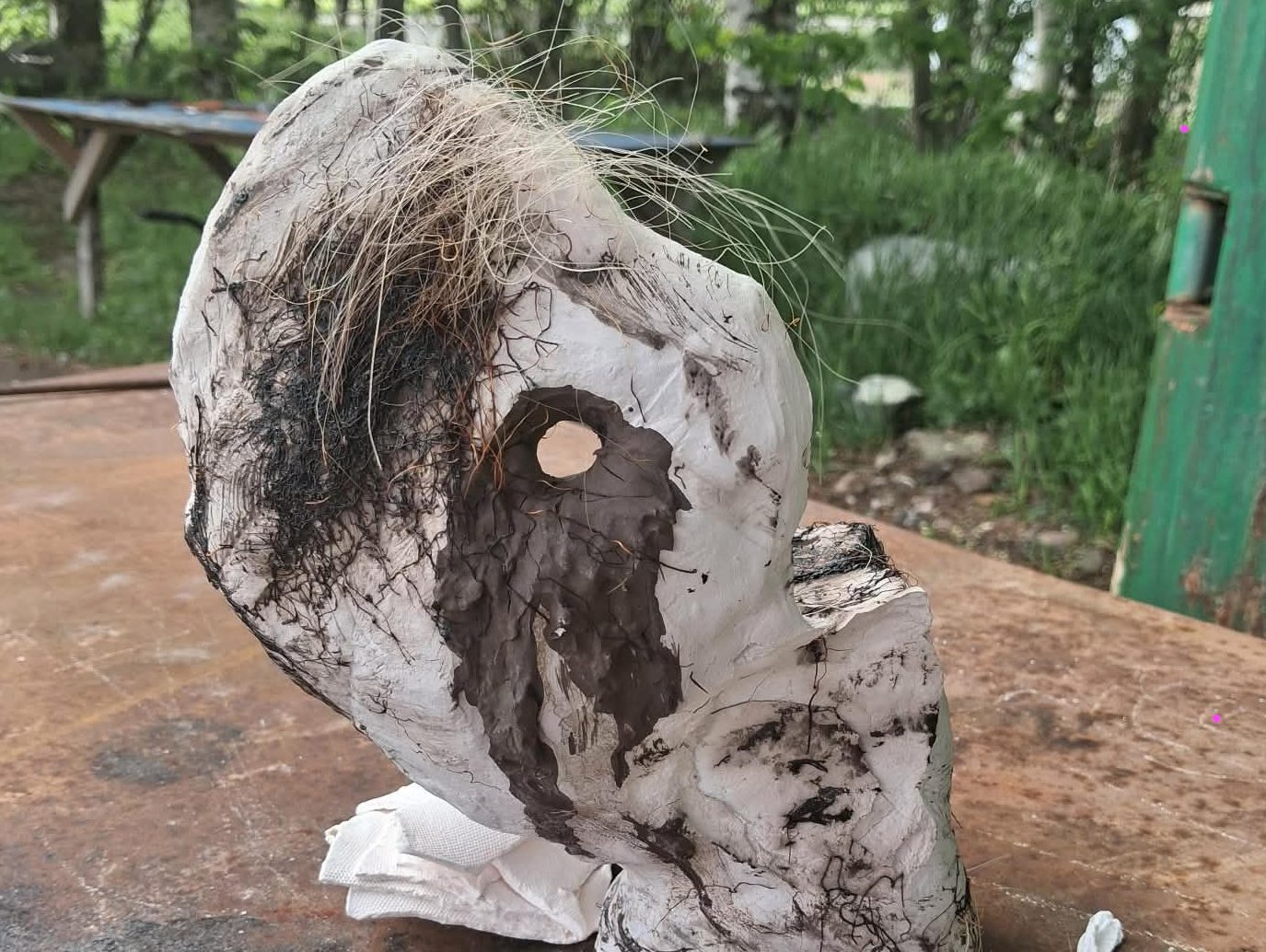
Something in-between
Above is the photo of my ceramic sound mask. As you can see, my sound mask became something in-between mask and sculpture. It has become not something that you wear but something that you hold with your hands. As you hold it, you need to move the mask/sculpture close to your face so that the little opening of the mask/sculpture align with your lips. That is the hole that you blow to make sounds… well…. mostly, air sound. Sometimes when you are lucky, you can also produce some (shrieking) pitches! You also have to close another hole with your thumb as you hold it, I was going to make an ocarina for this occasion but it did not work. The extra hole is the left-over of the ocarina making attempt, to make an ocarina/flute attached to the mask/sculpture.
The making of a wind instrument, whether it was a flute or ocarina, proved to be very difficult. There was a lot of trial and error as it was my first time to extensively working with clay. In a way, the inadequacy of my skill in making musical instruments made this whole mask/sculpture creature into something that lives in the world of in-betweenness. It was a happy accident. If the mask was made for something to help me getting into the “zone” between “here and now” and somewhere beyond our control, I feel it is rather appropriate that this creature itself also exists in the world of in-betweenness.
Mark making
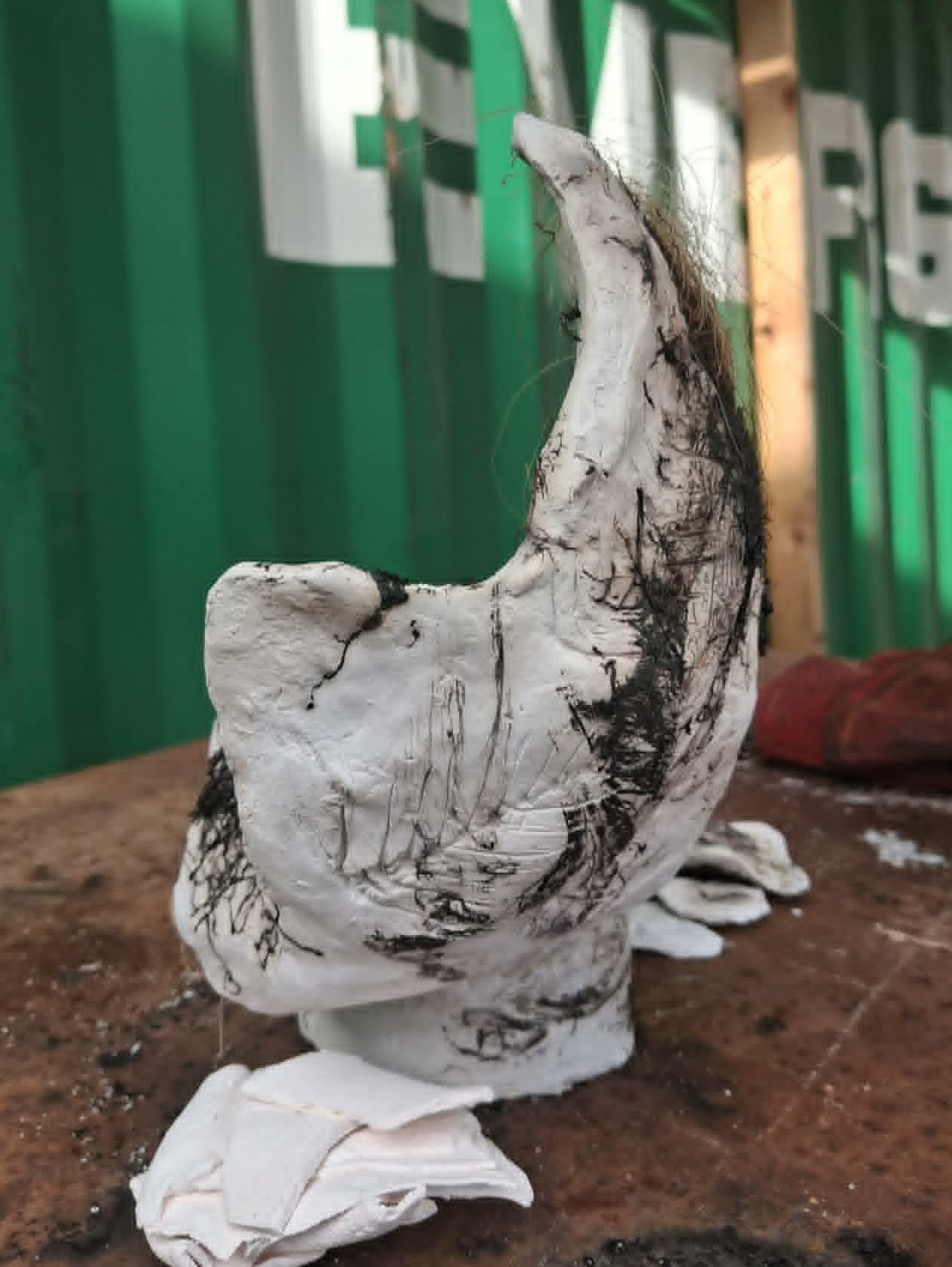
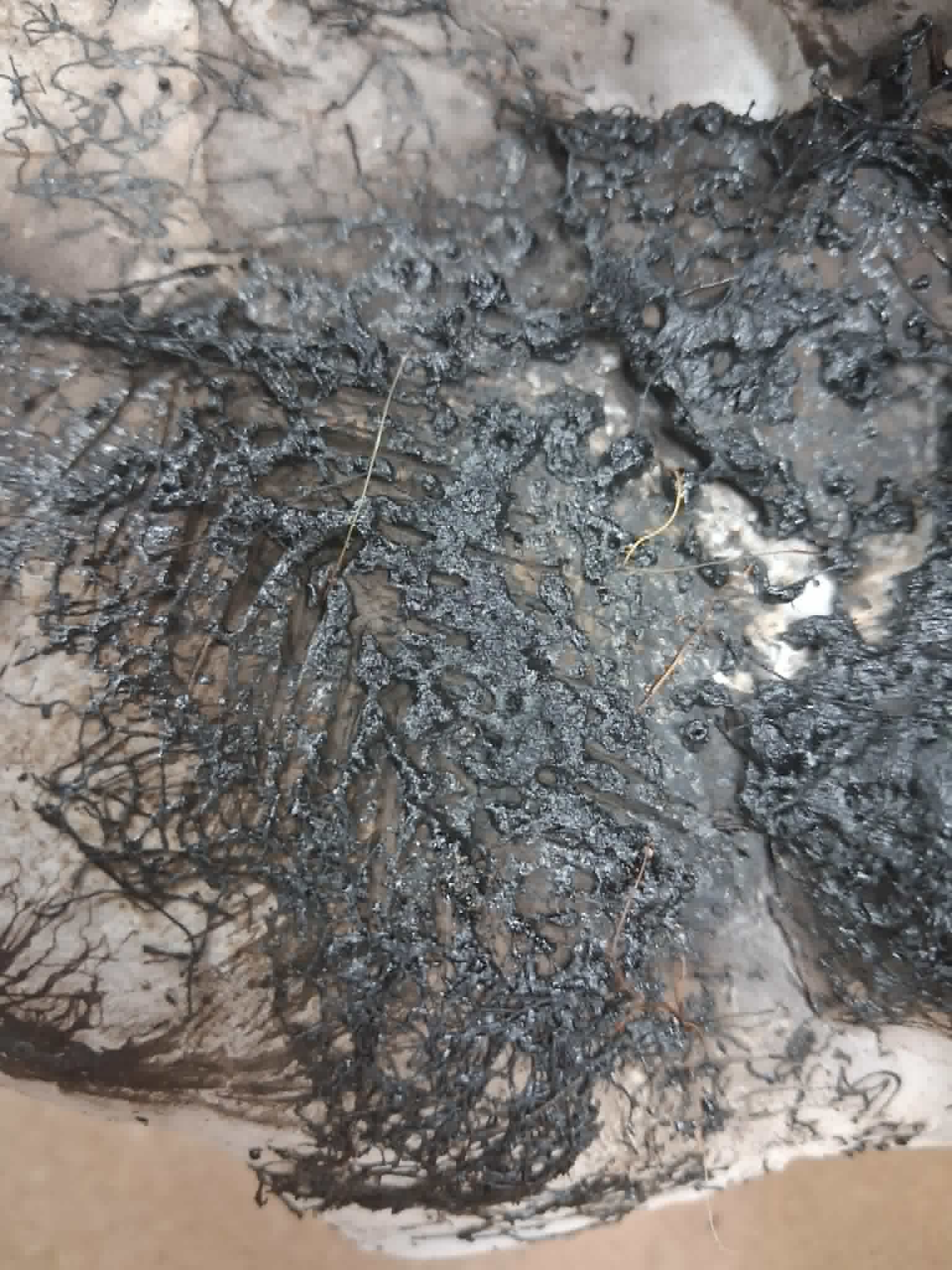
When my father died, one of the things that I felt was that my father’s influences throughout my life would remain, even though his physical form as a human-being is now gone. I found that the mark making process with clay is very similar to that, whether it is through making marks into clay with fish bones or with feather and horse hairs in the naked raku process.
Opposites
There were some very interesting findings of opposites in my process of making. These are:
- Letting go and control/clinging on/holding on
- Death and breath
I found that a lot of the process of grieving is something to do with letting go. You pay so much attention to make sure someone is well looked after, but you are reminded again and again that there are some elements in life that you cannot control.
It feels that the process of letting go is similar to letting go of control when your work goes through the firing process, and this is one of the reasons why I got interested in making ceramics. In addition, the naked raku method is very improvisational, making decisions of what to do on the spot after spending a very long time making the foundation of the work. In terms of the opposites of death and breath, one of the fellow artists pointed out to me that it was interesting that although my work was to do with death and grieving, I create the wind instruments that use breath to make sounds, because breath is a symbol of life too. The idea of making the wind instruments originated from the fact that my father used to play the flute, clarinet and recorder, but I also find it a very interesting coincidence.
More Fish
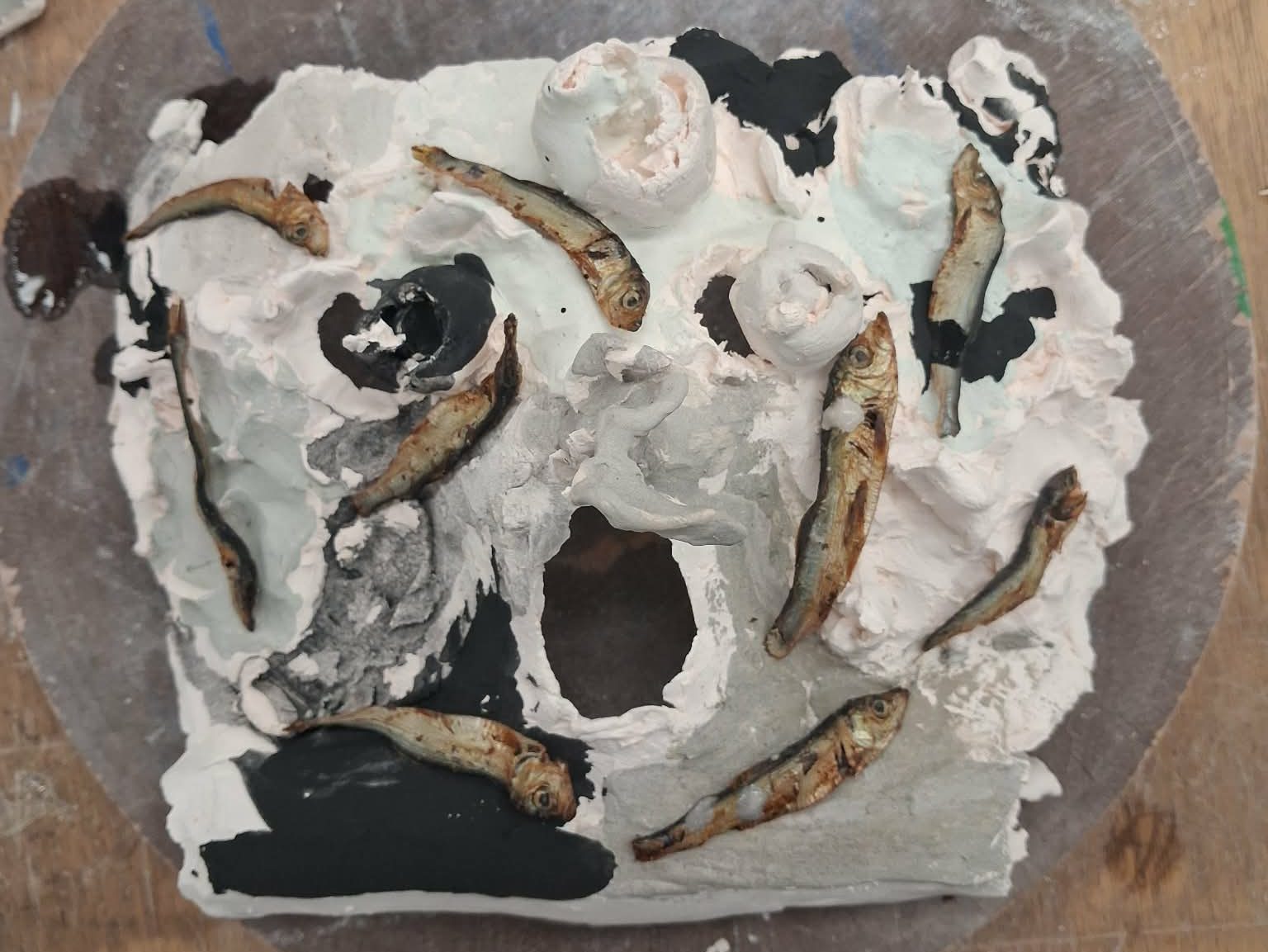
Although it did not make it to the final stage of the work, I also experimented with the lots of fish on top of the clay to see what kind of effect it might make when they are in the electric kiln. Unfortunately, the result was not as interesting as it looked before they went into the kiln, but it was a fun experiment anyway!
Anticipatory Grief
In terms of my work, when I decided to fire my mask/sculpture in the raku kiln and then apply the naked raku method to it, I was told by the technician that there is a danger that it might break as these methods are harsher than firing it in the electric kiln. Therefore, I mentally prepared myself for this possible eventuality. However, interestingly when my mask/sculpture came out broken after the first Bisque firing (even before the raku), I found myself emotionally hit by the fact too. It took me a while to process it and decide my next step.
I shared this experience to one of the staff members at SSW a couple of days later, she gave me an interesting analogy of similarities between the experience I had along with the grieving. Even when you think you are prepared to for something big to happen (such as a death or your work that you put some much effort into to make), it still hits you.
Musical Instruments
Collaboration with the elements of earth
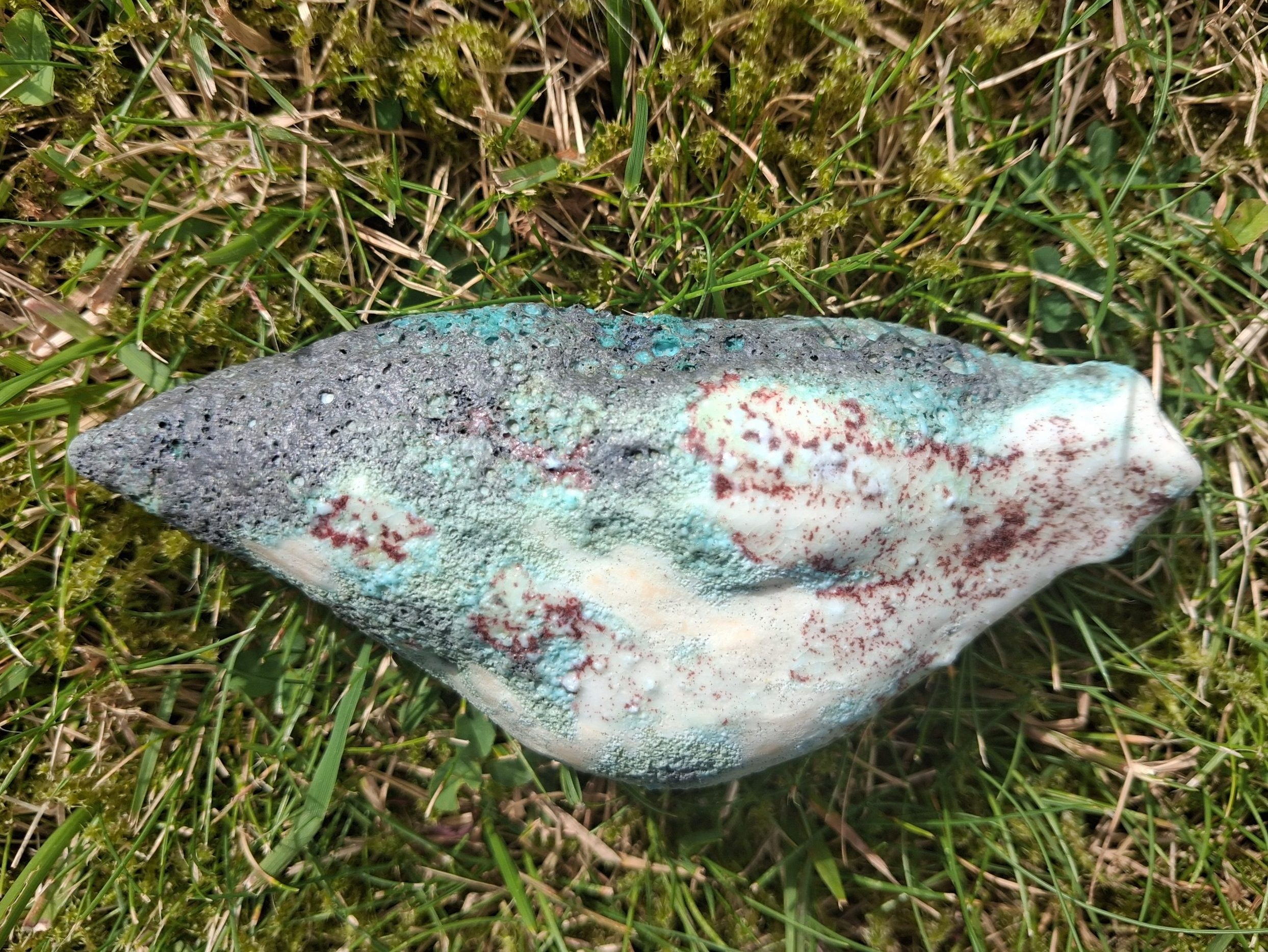
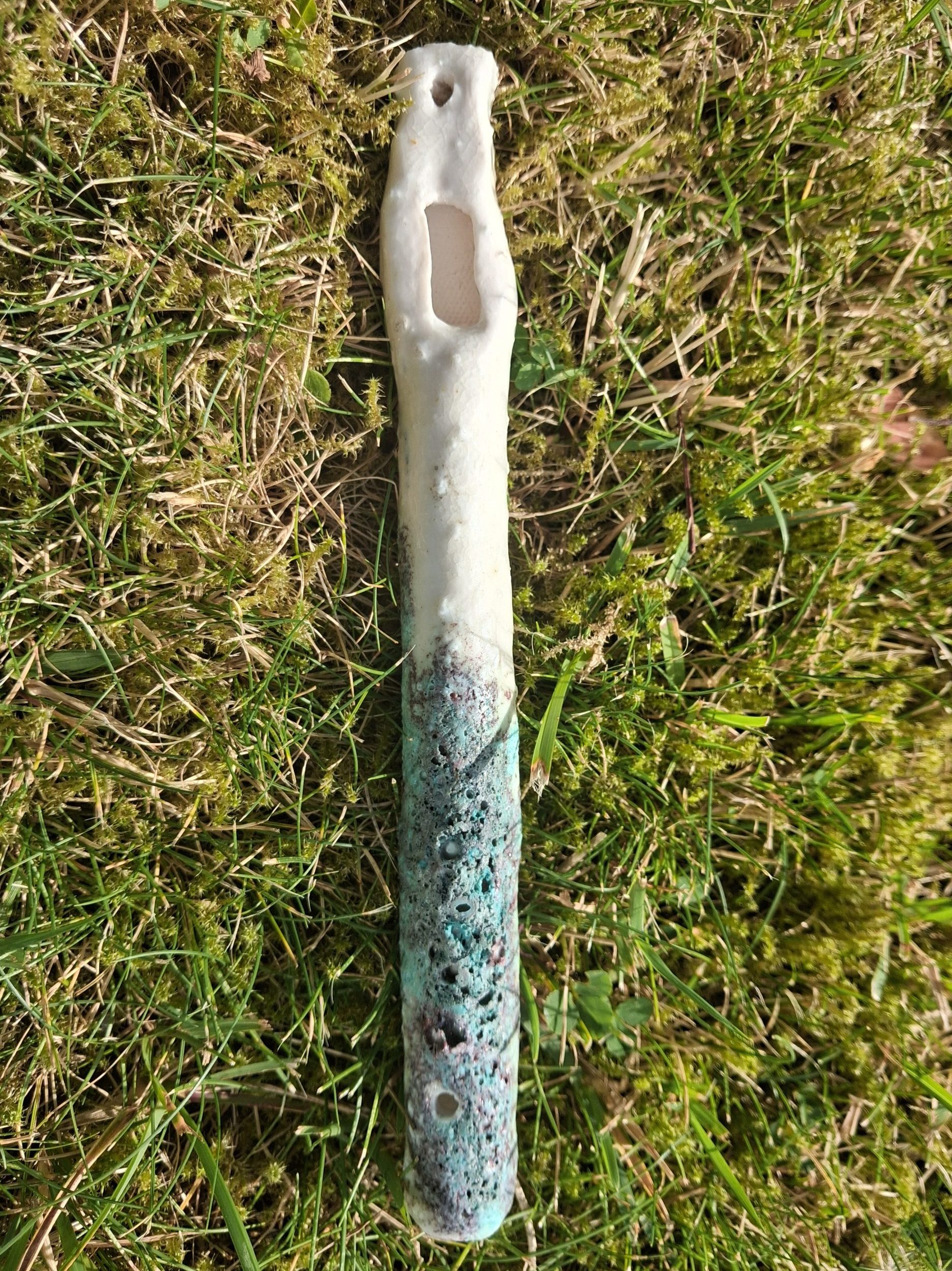
For my flute and ocarina, I used a small amount of my father’s ashes mixed with other glaze materials. Whilst I was mixing the glazes, I realised that my father and the elements of the earth (as the glazing for ceramics were extracted from rocks and minerals) were collaborating.
Vision Divina (Visio Divina) & Aural Divina
There was a very kind individual who offered to hear the story of my father and my grieving. She was a priest and told me about the idea of “vision divina” (Visio Divina) in her practice, a contemplative practice of praying or meditating with an image. She also told me that the “divina” can also be found in words or sound.
On an early evening towards the end of my residency, the time after my ceramic flute and ocarina came out of the final firing in the electric kiln, and after I managed to make some high pitches out of my ceramic flute, I found a blackbird that kept singing very similar pitches on top of the bothy at SSW. It was so interesting to hear because of the timing, and because it was singing for a very long time. It was my aural divina.
Shifting relationship to my works
I find it quite interesting that my relationship between the mask/sculpture and the musical instruments that I made later are quite different. To me, the mask/sculpture feels venerable, and raw. Since I kept some horse hairs and ashes from the naked raku on the mask/sculpture, I feel like it keeps changing every time I play it, and the relationship I have with it also keeps changing. Sometimes I like it. Sometimes it feels too fragile to even touch it. It feels like it has its own life.
On the other hand, my relationship with the instruments, flute and ocarina, are quite stable. They feel quite solid in their presence, and I like them whenever I see them. It is probably partly due to the different methods used for firing (the naked raku for the mask/sculpture, and glazing with electric kiln for my musical instruments), the impressions of these works are different. These differences are so fascinating.
Next Step and thank you
I am looking forward to developing this project in many different ways. First, since most of my residency at SSW was spent learning new skills to make sound mask and musical instruments with clay, I would like to go back to creating a piece of music, using the mask/sculpture and the flute and ocarina that I made, and interweaving with the music that my father loved.
Thank you everyone at SSW for all the generous and warm support. My special thanks go to Amy, the ceramics technician and a wonderful inspiring artist, who supported me every single step of the journey. I loved that whenever she noticed me poking my head out to see if she is available to answer my questions, she started to crack into laughter. Some fun moments!
And thank you for reading my blog!