

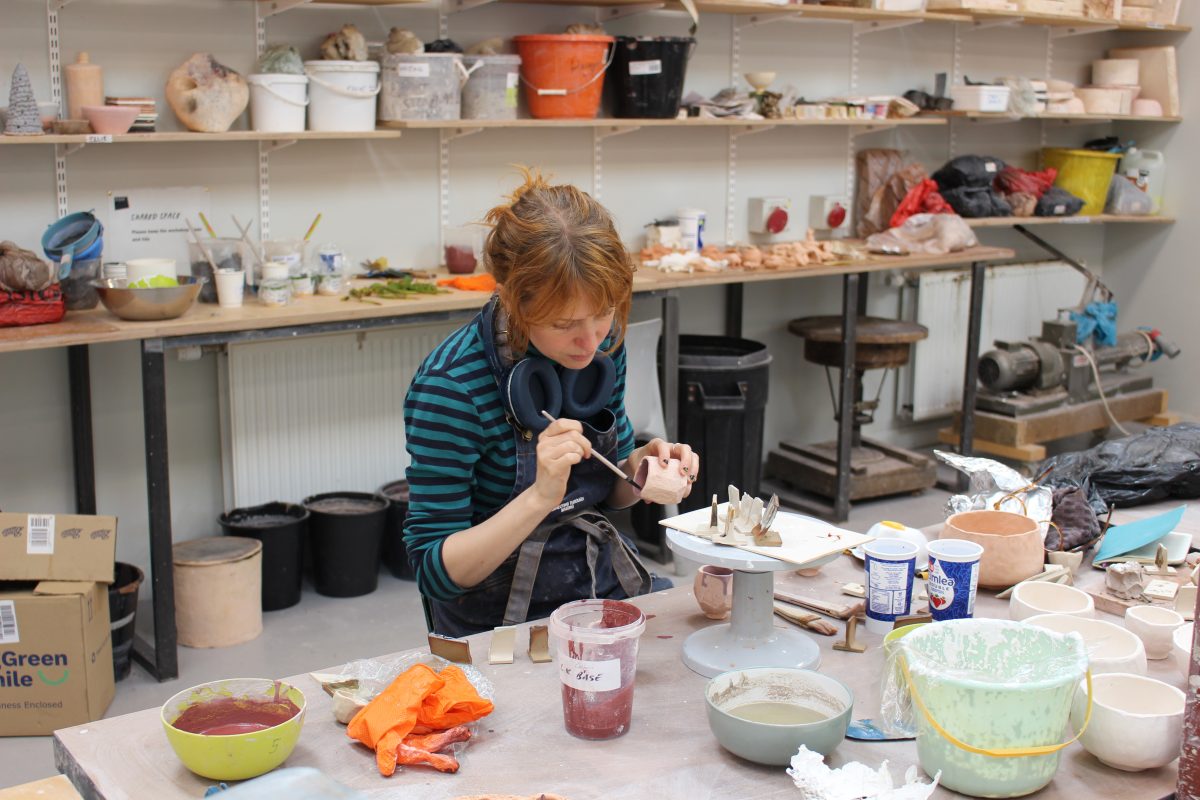
Artist and Researcher Ellie Ballantine shares observations and insight into her time working at SSW on a Scottish Graduate School for Arts & Humanities (SGSAH) Artist Residency. Over 3 months Ellie worked both on site in Lumsden and remotely, to explore Regenerative Materials and Community Knowledge within Arts Practice, alongside SSW’s Materials Garden and Community Making Space programme.
Words and images below by Ellie Ballantine
—
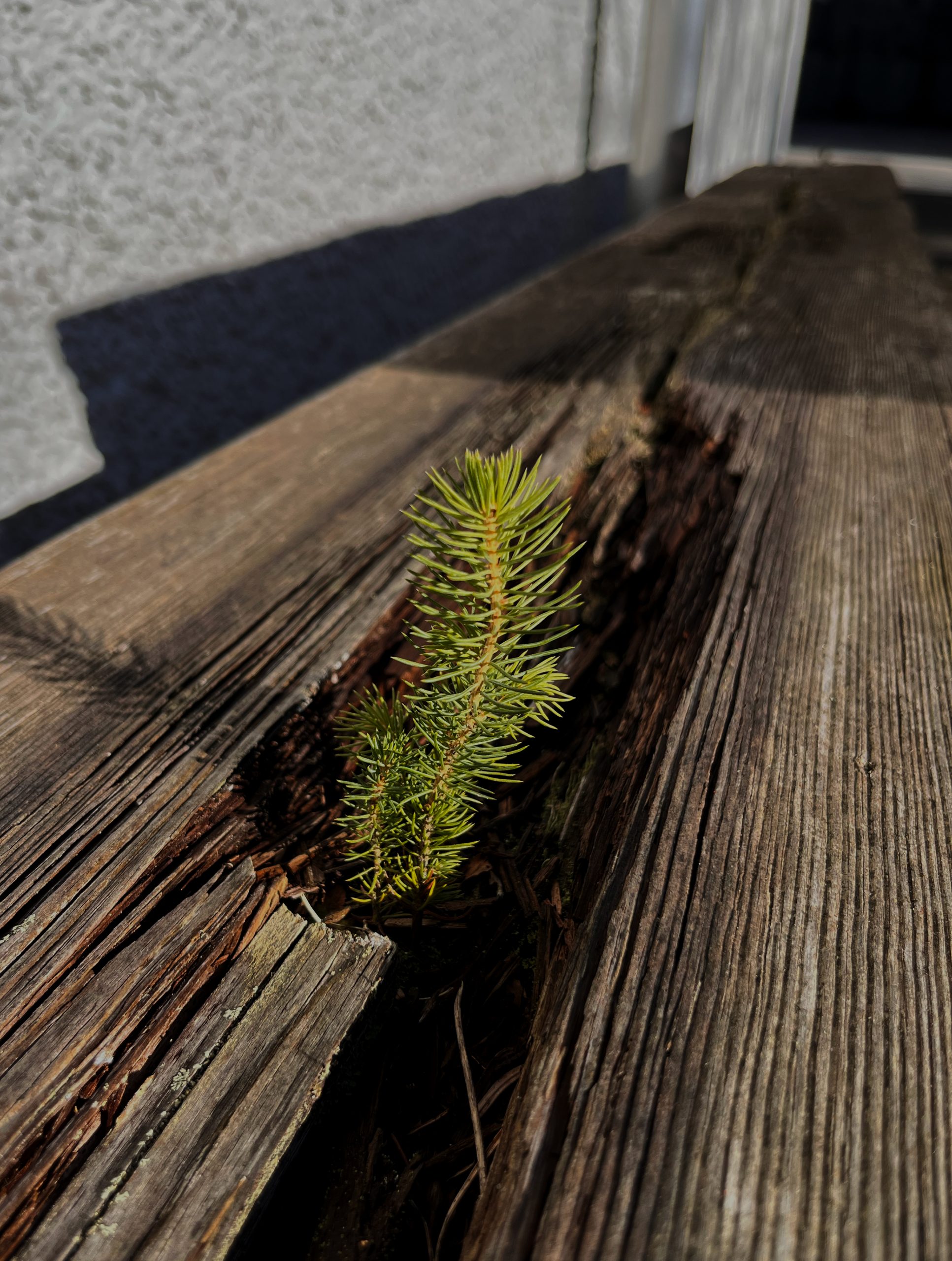
sitka spruce growing from a bench at SSW
early March
snowdrops not yet out
flowering white butterbur
When I arrive at SSW I am sick. It is March and a virus takes its sweet time to pass through me. Talking about the timelines of soil care and remediation with Jo, SSW’s Communities Producer, my frustration at losing precious time here comes into conflict with the lengthy process of coming to know a garden. Even though it is freezing, I am writing outside to cool a fever. There are curlews in the field, oyster catchers next to me. I can hear lapwings but cannot see them. Greylag geese are still here. Looking at SSW’s garden I see rosemary clinging on through the cold. Later I find out that rosemary is high in carnosic and rosmarinic acids and can support the immune system. How smelling its oil can improve memory, recall and alertness. I make a tea and take the rosemary into my body.
broom
juniper
hawthorn
I am at SSW for the first of three stays where I’m following questions as lines of thread, many of which lead back to plants. Over the last year, SSW have been developing their Materials Garden — as a space to grow and make and think with plants, primarily with community visitors from Lumsden and close by. SSW are developing research into ‘regenerative materials’, exploring plant-human relationships within local and hyper-local sites, and, as this relates to the garden, what plants might be happy here, what plants produce a dye colour, what plants support human bodies, what plants can the community learn with and how can the process of growing a garden be a regenerative act in itself.
beginnings of wild garlic
winter aconite
As a means of navigating my time here, I follow the project to some roots. I try to bring garden and plant-thinking into the workshop and workshop thinking into the garden. Splitting the project in this way allowed me to traverse what quickly became a false line of separation.
sphagnum moss
bell heather
wood forget-me-not
silver birch, red stems, covered in oakmoss
Leaving the garden be for the moment, I went on the hunt for waste across SSW’s buildings, considering regenerative materials first within this context. I turned over the soil in the workshops to see what remained — of materials from other practices and remains of experimental processes that I could build on. I dug into cupboards, buckets, biomass ash collection trays, shelves of glaze materials, surveying material traces from previous labour. Noting what was left behind as artist residents came and went, what materials were lying dormant, what materials were nutritive to the growth of new work.
I found a box of ash from a burnt elm, pine ash, steel off-cuts from metalworking, buckets of wild clay from Cruden Bay, dried and cracking with grasses weaving around the edges. I found ground white stone in an envelope; glaze chips; apple pulp from Jess Crisp’s session on paper making. I found paper waste and food waste. I found abandoned unglazed pots, and a large number of fired kiln cones, glossy and melted into curled shapes like leaning candles. I developed ash glazes using minimal ingredients, that would work in SSW’s electric kiln. I made whiting from shells to see if this aided the movement of the ash glazes in lower temperature oxidation firings. I used the dried apple pulp with some parian slip to make textured bowls, and coated broom pods from last year, now empty of seeds, with porcelain mixed with waste paper fibres, hoping they wouldn’t explode in the kiln.
wood anemones
yellow flag iris
willow beginning to seed
blaeberry turning green
nettles
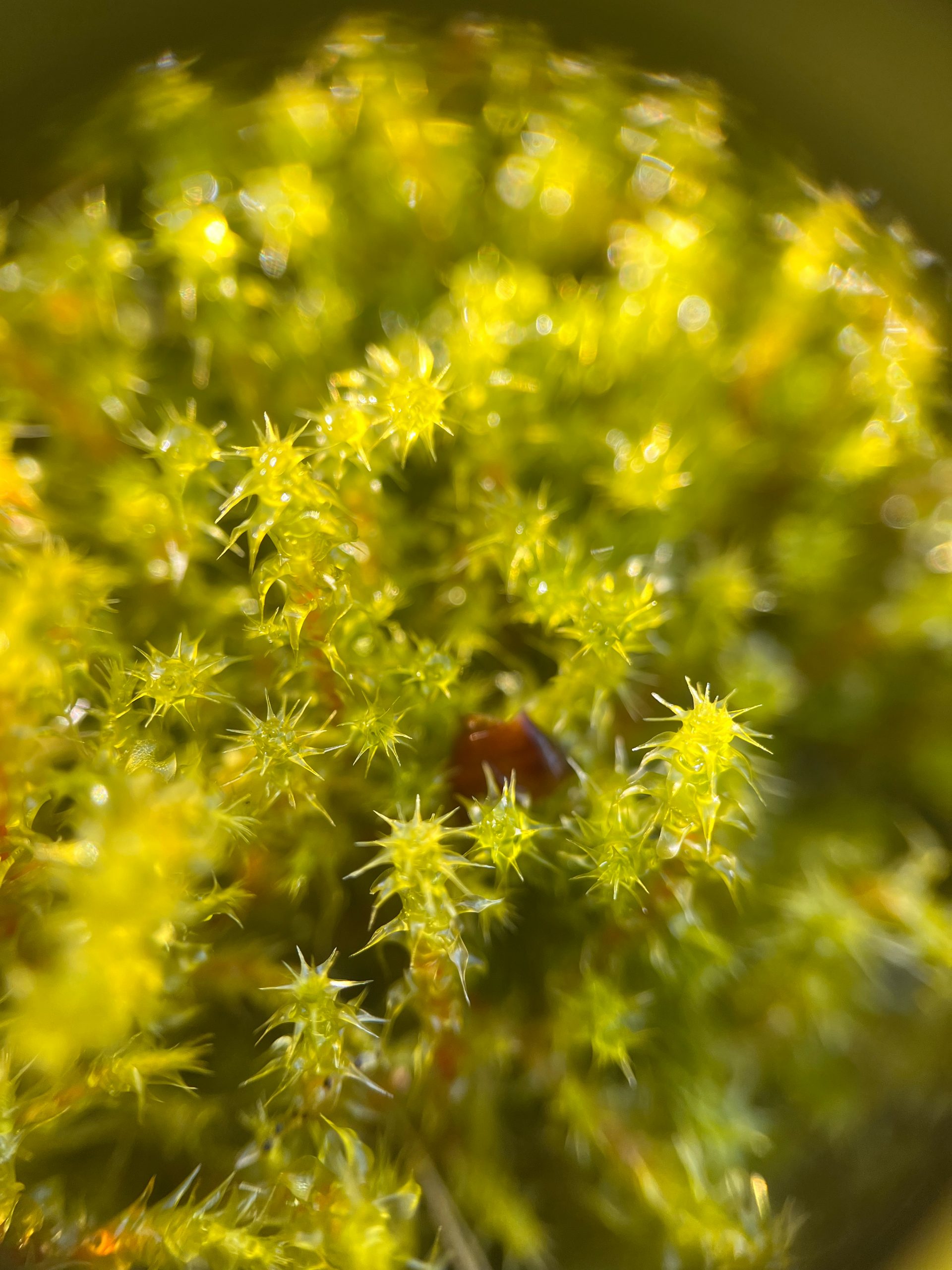
Broom fork-moss on Clova Estate, Lumsden
I was incredibly lucky that my stays at SSW coincided with the Caregiver Residency programme and had many fruitful conversations with the residents about the difficulty of regaining or regenerating a creative practice alongside caring for another person (I missed my daughter). How plant words/thinking (and there are a lot of plant metaphors here!) such as dormancy and seeds and finding the right time to make a move outwards, to leaf, are helpful in generating a care and patience for ourselves following periods of incapacity. We also talked about collaborations across asynchronous timelines of working with plants and place to think through collaboration and regeneration within creative practice. We talked about SSW’s garden being cared for by many hands, with practices from the previous year archived within the soil. The pansies, woad, foxgloves and rosemary remaining.
bluebells, a little later than in the south
wood rush
buddleja
ragwort
cherry blossoming
We wondered how an object could feature as a point of connection and collaboration between artists unable to work alongside each other at the same time. I made a double-necked jug whilst thinking about the winding trunks of SSW’s birches, their abilities to raise nutrients from deep in the soil and their phytoremedial properties. I gave this jug over to Alicia Matthews, who generously cared for it alongside her own works, making a glaze that I then raku-fired when I returned and she had left. We thought about how various practices, innovations and all the care inherent in the sharing of workshop space with another artist, were a type of material that was generative, even when asynchronous — how this innovation and care could regenerate a practice in dormancy. I found a bowl of vitrified oyster shells left by Harriina Räinä from her residency at SSW earlier this year and spoke to her about using them. We talked about her desire to leave the shells, already a waste product she had sourced from the seafood industry, for use again by another maker, keeping them in circulation for as long as possible. Because regenerate, taking it back to its roots, suggests bringing something forth again and ‘to create again’.
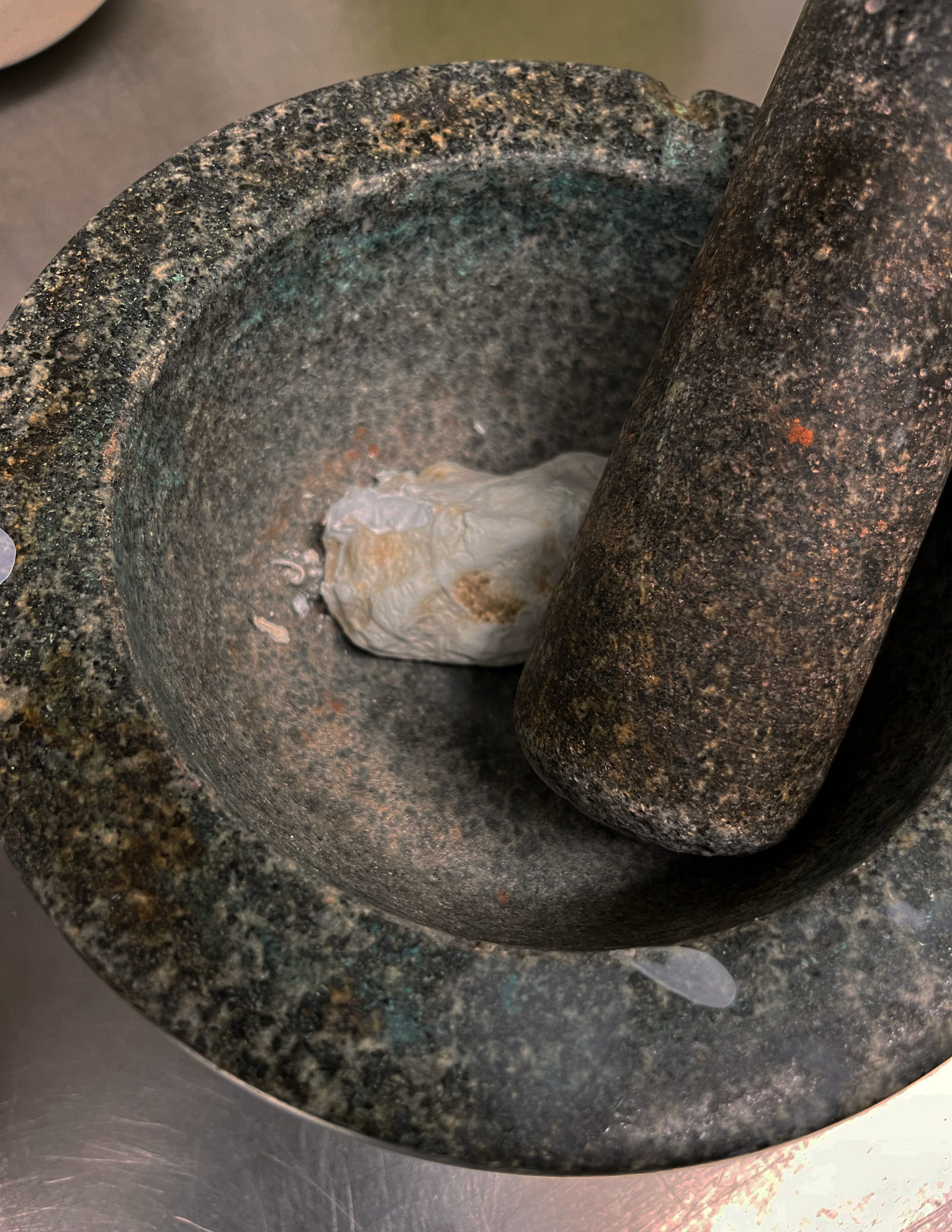
Grinding oyster shells for use with ash glazes
Coming back to plants, I wondered what, if anything, could be thought of as waste to a plant and how thinking in this way was a practice of attentiveness to a plant’s phenological cycles. As I learned more about Lumsden’s wild plants, I also mapped the forest floors. How could I use seed pods, now empty of seeds, in new work? What could I do with the dried out grasses and wood sedge from last year? The empty beech nut shells? Nearly all of my writing on this project became about relationships between care and time. How could we generate care for ecoystems around Lumsden whilst balancing this with a wish to bring dye plant learnings into their community spaces? I made a list of all the dye materials that could be harnessed from parts of plant that had been lost or discarded — seed hulls, empty pine cones, fallen tree bark — parts of the plant left after their seeds had scattered or been eaten. Of course nothing is ever waste to soil and the processes above heavily simplify so much detail, but working in this way allowed us to consider how learning about potential dye materials could also curate attentiveness to particular plants and their relations with other beings within their proximity.
common haircap moss
hogweed
flowering cowslips
Returning to the SSW’s garden, each visit was different. Whenever I arrived, I would look to see what was new (to me). How was the ground elder beginning to cover the shady bed by the mossy wall? Was the close rosette of foxglove leaves bigger than last time? The plants I couldn’t identify around Lumsden in March were showing more of themselves in May. In SSW’s Thursday Club, plans were being made for what plants to grow and how this was becoming a question of which plants to ‘learn with’ this year. With the SSW Kids Holiday Club, we went out in the woods with a wee book of text scores for finding our plant neighbours and made cyanotypes to celebrate them.
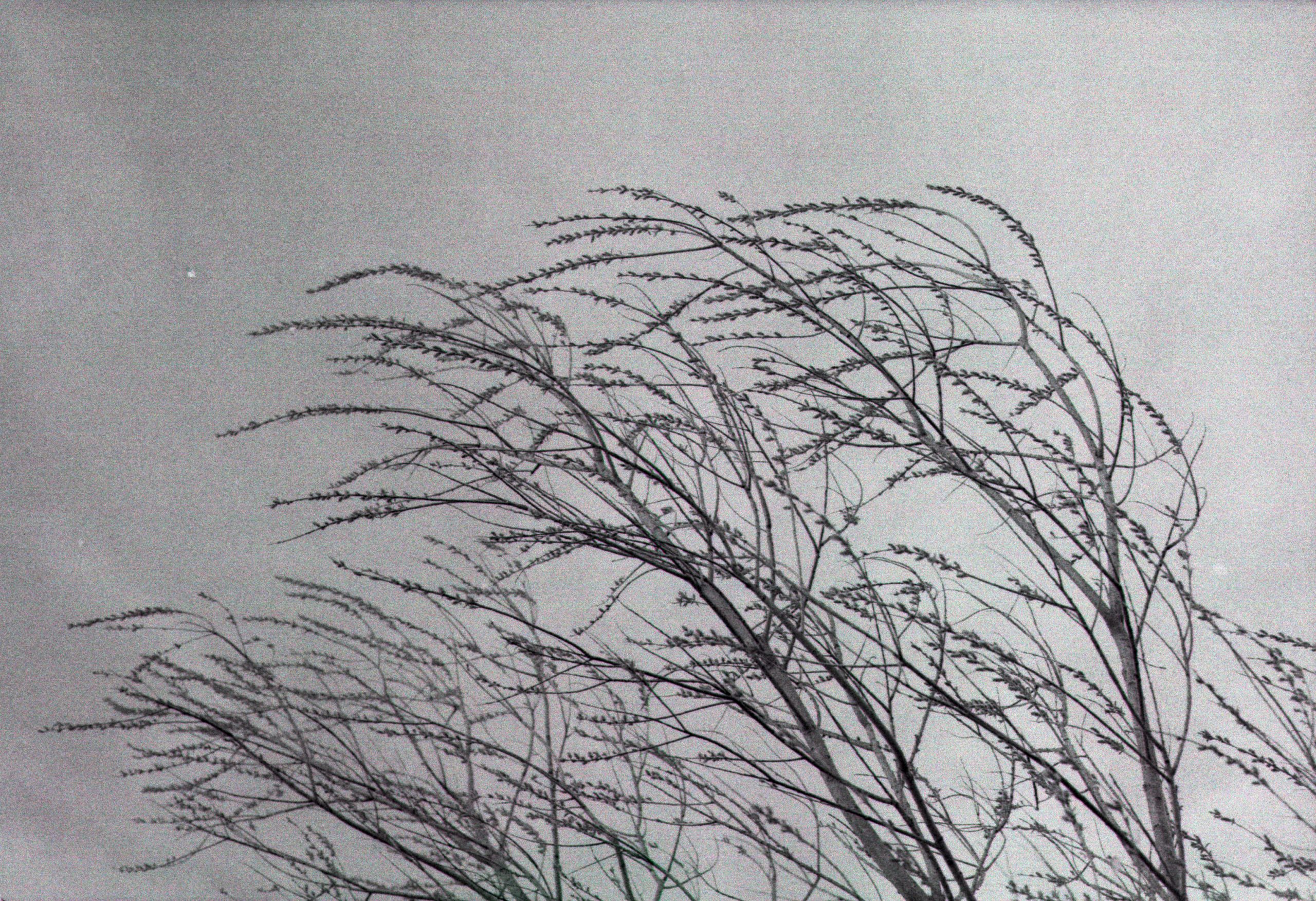
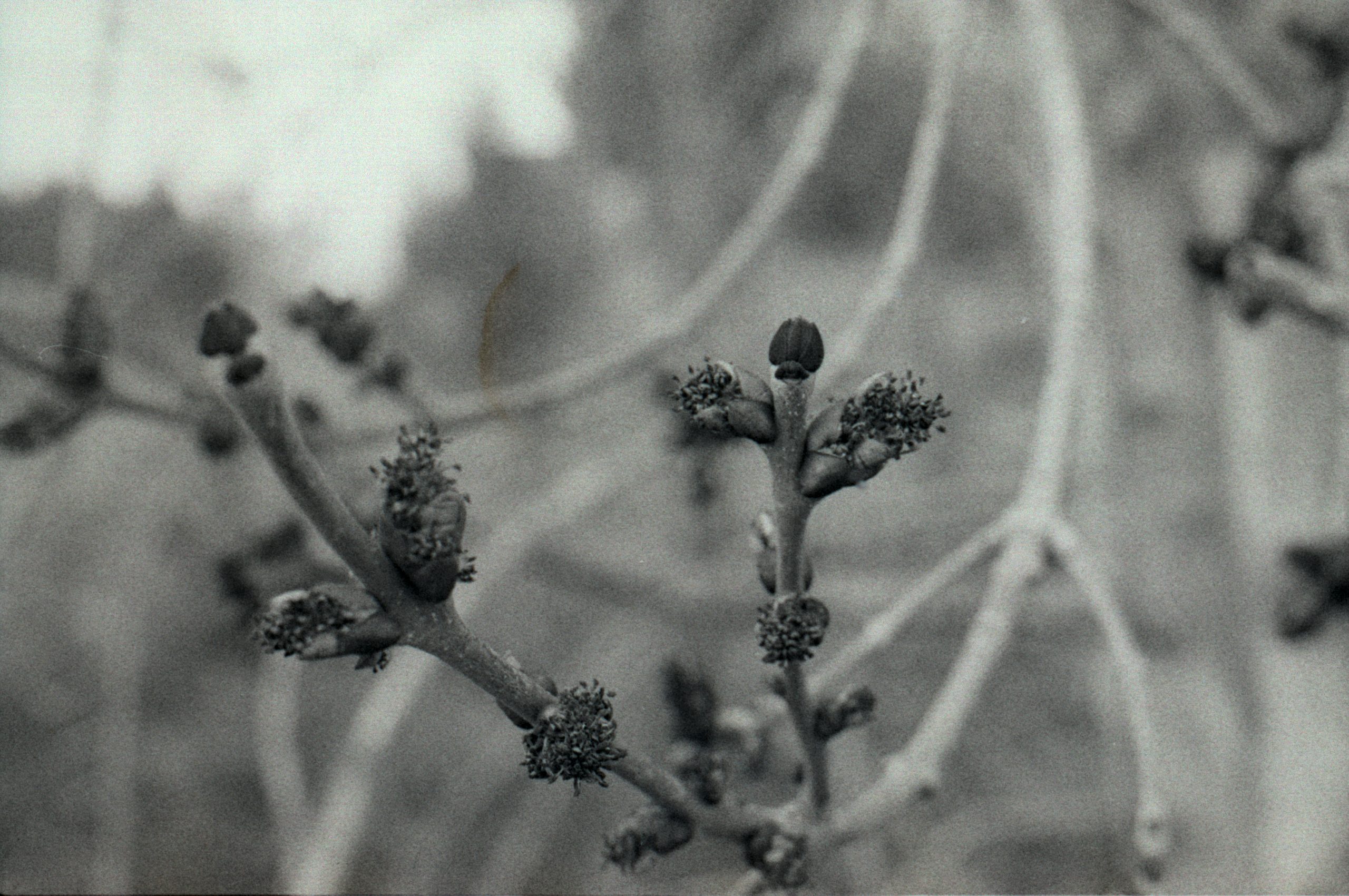
Ilford HP5 35mm film: goat willows and ash flowers, developed with rosemary
Speaking to SSW’s community visitors, ceramics subscribers and all those around Lumsden who were generous with their time, I went back to to the questions that SSW had provided to initiate this project.
rhododendron ponticum flowering
beginnings of silverweed
cleavers
hawthorn flowers
There were many. Although this offers a challenge for finding ‘a way in’ during a short research project, SSW are asking vital questions. Questions that are closely interrelated but that don’t allow easy or resolvable answers — plant-related questions that responded like plants, pushing back against tidy and neat impositions of control. Questions that spread, leaked, connected spaces, thoughts, people, places. So, instead I used my short time within the garden and workshop spaces to ask more questions — to allow these questions to grow into a weedy, overgrown, promiscuous garden of thoughts, connections, asynchronies, synchronies, challenges, attentiveness to positionalities and what questions we can look to next. The only answers, if any, are that working with plants in a garden, a studio…any space, and being with them intimately by bringing them into our bodies, is inextricably linked to ways of thinking about time, soil, collaboration with humans and more-than-humans; the legacies of colonialism inherent in oppressed and oppressive knowledge systems, naming systems; questions of labour; practices of extraction.
Rather than limit the experience of thinking with plants in response to these questions by writing a report (which I tried and failed to do!), I made a knotty, bramble-like map for SSW. Like a garden each section is just a way of organising that does little to contain how complex plant-human relations are, with connections criss-crossing and becoming tangled. The resource-as-garden-map is something to be navigated slowly, added to, something that should grow, that should sprout more questions, ones that don’t expect non-contradictory answers. Something to wander around, following threads as they connect to other ideas — like wandering around a garden. From this map, SSW Co-Director Sam Trotman and I worked on a research poster that celebrates Lumsden’s plant communities and planty-ways of thinking. We talked about moss-thinking, forestry-thinking, sowing and harvest thinking and ways to celebrate all the garden-based making activities undertaken so far.
Leaving behind the map, the poster and all of the plant-based ceramic, dye and photography recipes, I hope that someone else will turn these over from the soil of the workshop and that they grow into something else at the right time.
On my last day, the gardening group placed wishes into a wild clay crucible I had made, referencing the archaeological remains found in nearby Rhynie and the long history of transforming materials into something new. A legacy that SSW continues in both the garden and workshop. We thought about soil as the ultimate crucible, where things are altered. Life to death then to life again. We covered these wishes for the garden with high-nutrition soil and marigold seeds and buried it in one of the beds. Over time, the wild clay will dissolve back into soil.
green alkanet
common dog violet
greater stitchwort
ash finally leafing